
Skip to content
Interface language

Education issues

International comparisons Latest updates

Compare different education contexts without transferring conclusions wholesale.

7 featured itemsLast 30 days 2 itemsTotal collected 7 items

updated

Featured: International comparisons

11 NovWedItems 1–7
  1. Higher Ed Dive
    InternationalUpdate
    Topic illustration of education researchers examining charts and notesIllustration

    International enrolment declines at US colleges: what pressures does a survey reveal?

    An online survey of 203 US higher-education institutions by NAFSA and its partners found that most responding institutions reported a decline in international postgraduate enrolment, while 45% reported lower undergraduate enrolment. These are institutional self-reports, not national student counts. Respondents' explanations alone cannot establish that federal policy caused the decline.

    Why read: The survey sample, policy pressures and changes at different degree levels are clearly identified. This provides a useful international higher-education story that distinguishes institutional self-reports, actual student numbers and causal explanations.

30 OctFri
  1. Jiemian Education
    ChinaUpdate
    Topic illustration of a teacher and students discussing books and ideasIllustration

    China's Vocational Colleges Begin Extending Overseas Partnerships into Courses and Industry Settings

    Jiemian News interviewed a representative of Fujian Vocational University of Software Technology and reported on the university's partnerships with institutions, education departments, and organizations in Thailand and elsewhere, as well as teachers' and students' participation in livestream sales of local agricultural products. It describes attempts to extend the internationalization of vocational education beyond short courses into curricula, industry, and talent development. The number of partnerships and most examples come from school interviewees; they do not yet demonstrate that courses run over the long term or establish outcomes for local students' employment or skills.

    Why read: The article offers concrete teaching and industry settings for international vocational education partnerships. It allows readers to observe whether cooperation develops from agreements and short-term projects into sustained courses, faculty exchanges, and verifiable learning outcomes.

6 OctTue
  1. World Bank
    InternationalResearch
    Topic illustration of education researchers examining charts and notesIllustration

    World Bank Uses Implementation Science to Track Education Reform, Distinguishing Reach from Learning Outcomes

    The World Bank describes a remedial-teaching model piloted in 400 Rwandan schools, along with related baseline and midline surveys, and notes that learning outcomes still require future evaluation. A separate teacher-training project has reached many schools, but the number reached cannot substitute for improvements in student skills.

    Why read: Clearly illustrates the distinction between evidence about implementation and evidence about outcomes.

29 SeptTue
  1. OECD
    InternationalResearch
    Topic illustration of education researchers examining charts and notesIllustration

    OECD Education at a Glance Focuses on Teacher Shortages: Cross-National Averages Need to Be Read in Context

    The OECD's 2026 Education at a Glance highlights teacher shortages, reporting that about 9.1% of primary and secondary teachers in the sampled countries were not fully qualified. The indicator is comparable across countries, but national definitions, missing values, and reference years differ; the average cannot be used directly to assess a particular country's schools.

    Why read: A foundational data entry point for comparing education systems internationally.

10 SeptThu
  1. UNICEF
    InternationalResearch
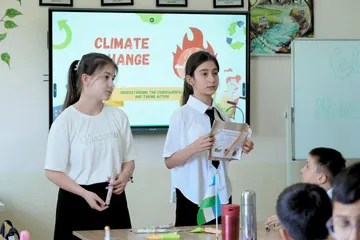
    Source image: UNICEF Estimates Climate Disasters Disrupted Learning for More Than 171 Million Students in 2025Source

    UNICEF Estimates Climate Disasters Disrupted Learning for More Than 171 Million Students in 2025

    In an analysis published in September 2026, UNICEF estimated that climate disasters disrupted the education of more than 171 million students worldwide in 2025. This is a retrospective estimate, not a count of disruptions that have already occurred in 2026; the numbers affected by different disasters cannot simply be added together.

    Why read: Climate risk is an important global issue for continuity of education.

25 AugTue
  1. Economic Policy Institute Education
    InternationalResearch
    Topic illustration of education researchers examining charts and notesIllustration

    The U.S. teacher pay gap remains large: how was 25.2% calculated?

    The Economic Policy Institute used Bureau of Labor Statistics data to estimate that in 2025, weekly wages for U.S. public school teachers were 25.2% below those of comparable college graduates. After employer-paid benefits are included, the estimated total compensation gap was 14.5%. These are adjusted differences between occupational groups; they do not show the causal gain an individual would receive by changing careers.

    Why read: A closer look at an older report’s methods: how wage, benefit and geographic definitions shape discussion of the teacher workforce. The estimates can be compared with recruitment and retention data.

19 JanMon
  1. OECD
    InternationalResearch
    Topic illustration of a teacher and students learning with digital tools and booksIllustration

    OECD Digital Education Outlook: better assignment performance with generative AI does not necessarily mean learning

    The OECD’s 2026 Digital Education Outlook discusses the use of generative AI in teaching, learning and governance. It cautions that when a task is handed directly to AI, assignment performance may improve without a corresponding gain in learning. The report offers policy and research recommendations; it does not mean every tool has been evaluated for causal effects.

    Why read: Offers international evidence and a clear distinction between performance and learning for discussions of AI in classrooms.