Skip to content
Interface language
10 SeptThu
  1. UNICEF
    InternationalResearch
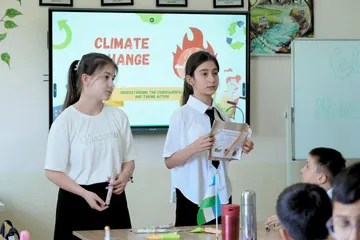
    Source image: UNICEF Estimates Climate Disasters Disrupted Learning for More Than 171 Million Students in 2025Source

    UNICEF Estimates Climate Disasters Disrupted Learning for More Than 171 Million Students in 2025

    In an analysis published in September 2026, UNICEF estimated that climate disasters disrupted the education of more than 171 million students worldwide in 2025. This is a retrospective estimate, not a count of disruptions that have already occurred in 2026; the numbers affected by different disasters cannot simply be added together.

    Why read: Climate risk is an important global issue for continuity of education.
4 SeptFri
  1. Education Endowment Foundation
    InternationalResearch
    Source image: Schools in England Report: Literacy and Attendance Are the Main Barriers for Disadvantaged PupilsSource

    Schools in England Report: Literacy and Attendance Are the Main Barriers for Disadvantaged Pupils

    An EEF-commissioned analysis of more than 1,200 Pupil Premium strategy statements from schools in England found that 91% mentioned literacy and English issues and 83% mentioned attendance. It reflects challenges identified by schools in their documents; it is not an independent measure of students' skills or absences.

    Why read: Shows how schools define problems and reminds readers to distinguish self-reports from outcomes.

1 SeptTue
  1. Journal of East China Normal University
    ChinaResearch
    Topic illustration of education researchers examining charts and notesIllustration

    Longitudinal Survey Examines the Limits of Gaokao Identification: The University Development Process Still Matters

    Using a longitudinal survey of students at Double First-Class universities, the authors argue that scores offer an initial signal for identification, but have limits in identifying broader competencies; university courses, student–faculty interaction, and participation also shape development. The abstract cannot establish causal effects across all universities.

    Why read: Brings selection and subsequent development into the same research question, avoiding a discussion limited to exam scores.

31 AugMon
  1. Government Portal of the Ministry of Education of the People's Republic of China
    ChinaUpdate
    Topic illustration of a teacher and students discussing books and ideasIllustration

    Five-Year Special Education Action Plan: Expand Resources and Emphasize Inclusion

    Seven departments issued a 2026–2030 action plan for special education, setting goals including keeping compulsory-education enrollment for school-age children with disabilities above 97%, and arranging support across schools, classes, and departments. The target is not newly observed data showing that the goal has already been achieved.

    Why read: A specific national policy concerning educational access and inclusive education.

27 AugThu
  1. Flip Education
    ChinaUpdate
    Topic illustration of a teacher and students discussing books and ideasIllustration

    Taiwan Public Primary and Junior High Schools Still Have Substitute Teacher Vacancies Before Term Starts: What Comes After Filling the Posts?

    Flip Education reported teacher vacancies in public primary and junior high schools in Taiwan ahead of the 2026–27 school year (the 115th academic year in the local calendar). Citing Ministry of Education statistics as of August 25, it said there were still 614 substitute-teacher vacancies in public junior high and elementary schools. It also reported that Taipei's Jinhua Junior High School had seven vacancies during the summer and still had not filled them after 18 rounds of substitute-teacher recruitment. The article also interviewed teachers' unions and principals about assigning excess teaching hours, staff turnover, and retention. The statistics are from before the school year began; individual school cases and interviewees' views do not represent every school in Taiwan, nor do they establish the final scale of vacancies during the term.

    Why read: The article connects teacher vacancies, temporary substitutes, and excess teaching hours for current staff to classroom continuity, and reminds parents to pay attention to whether teachers can remain in post. It presents both official teacher-preparation rates and teachers' organizations' observations from the field, which warrant follow-up checks on recruitment and changes in teaching assignments during the term.

26 AugWed
  1. Teach For Taiwan
    ChinaCommentary
    Source image: How a rural Taiwanese first grader rebuilt his confidence that he could learnSource

    How a rural Taiwanese first grader rebuilt his confidence that he could learn

    Teach For Taiwan (TFT) published alumna Tsai Chi-pei’s recollection of her teaching. While serving in Gukeng Township, Yunlin County, she observed that a first grader, Xiao-yu, often said “I can’t” after comparing himself with his older sister and drawing on earlier classroom experiences. The teacher began using manipulatives, stories and games to help him learn to tell time, and noticed that he later became more willing to ask questions and practise. This is one teacher’s retrospective account of an individual child. Changes in achievement cannot be attributed to any single teaching method, and the account does not represent all students in rural areas.

    Why read: A concrete account of how a teacher responds when a student doubts her own ability in a rural classroom. It can support discussion of teacher–student relationships, psychological safety around mistakes and everyday remedial teaching.

25 AugTue
  1. Economic Policy Institute Education
    InternationalResearch
    Topic illustration of education researchers examining charts and notesIllustration

    The U.S. teacher pay gap remains large: how was 25.2% calculated?

    The Economic Policy Institute used Bureau of Labor Statistics data to estimate that in 2025, weekly wages for U.S. public school teachers were 25.2% below those of comparable college graduates. After employer-paid benefits are included, the estimated total compensation gap was 14.5%. These are adjusted differences between occupational groups; they do not show the causal gain an individual would receive by changing careers.

    Why read: A closer look at an older report’s methods: how wage, benefit and geographic definitions shape discussion of the teacher workforce. The estimates can be compared with recruitment and retention data.

4 AugTue
  1. Ministry of Education of the People’s Republic of China
    ChinaUpdate
    Topic illustration of a teacher and students discussing books and ideasIllustration

    Science education’s Learning by Doing initiative calls for at least one inquiry task each semester

    The Ministry of Education introduced the action guidelines, which call for inquiry-based practice to be organized within existing instructional hours. Each student is to complete at least one task per semester, lasting no fewer than four class periods, with an emphasis on process-based assessment. The quality of implementation will still depend on teachers, resources and local arrangements.

    Why read: The guidelines specify the frequency and instructional time for classroom inquiry, making them useful alongside resources on implementation.

1 JulWed
  1. Journal of East China Normal University
    ChinaResearch
    Topic illustration of education researchers examining charts and notesIllustration

    Survey of 3,483 teachers finds an association between time pressure and knowledge sharing

    The study analyzed 3,483 questionnaire responses from primary and secondary school teachers using structural equation modeling to examine knowledge sharing and its associations with sharing capacity, collaborative lesson planning and time pressure. The survey model describes patterns of association; by itself, it cannot prove that reducing workload will increase knowledge sharing.

    Why read: The findings offer a mechanism to examine in the organization of school-based professional learning.

29 JunMon
  1. Ministry of Education of the People’s Republic of China
    ChinaUpdate
    Topic illustration of a teacher and students discussing books and ideasIllustration

    Education Development 15th Five-Year Plan released: demographic change and resource allocation in one framework

    The plan brings changes in the school-age population, the allocation of teachers and funding, and education digitalization into a five-year framework. Its release sets strategic priorities and policy instruments; it does not mean that local measures have already been implemented. Local implementation will need to be followed to assess specific school places and investment.

    Why read: An overarching framework for allocating resources across education stages, with a clear hierarchy relative to later, more specific policies.

1 JunMon
  1. Journal of East China Normal University
    ChinaResearch
    Topic illustration of education researchers examining charts and notesIllustration

    Comparing teaching texts from six large language models: strength in higher-order questions does not mean classroom effectiveness

    The study compared multidisciplinary teaching texts generated by six large language models with teachers’ instructional materials, using three dimensions: value guidance, knowledge construction and thinking development. The objects of evaluation were texts, not student learning outcomes; the findings cannot establish that large language models teach better than teachers in classrooms.

    Why read: Provides a concrete research design and clear boundaries around what is evaluated in discussions of large language models for education.

1 MayFri
  1. Journal of East China Normal University
    ChinaResearch
    Topic illustration of a school counselor listening to a studentIllustration

    An education ecosystem index seeks to measure equity, burden and student development together

    The paper constructs an index with five dimensions and reports a 2024 assessment based on 10,651 household-survey responses across 31 provincial-level regions. This is an evaluation framework proposed by the authors; scores and regional clusters depend on the indicators, weights and sampling design and should not be treated as an official ranking.

    Why read: Adds to discussion of education assessment beyond a single examination score.

10 AprFri
  1. Ministry of Education of the People’s Republic of China
    ChinaUpdate
    Topic illustration of a teacher and students learning with digital tools and booksIllustration

    Five ministries set out an AI-in-education agenda spanning curricula, applications and governance

    Five government departments issued an action plan that sets tasks for AI courses in primary and secondary schools, teachers’ ability to use AI, pilot bases for education applications and safety governance. The 2030 targets are policy aims, not evidence that classroom outcomes have already been validated.

    Why read: The national policy text covers curricula, applications and governance and can be read alongside classroom studies evaluating AI-generated instructional materials.

12 FebThu
  1. Ministry of Education of the People’s Republic of China
    ChinaUpdate
    Topic illustration of a teacher and students discussing books and ideasIllustration

    Vocational education reform extends from program catalogues to curricula, teachers and practical training

    The Ministry of Education identifies programs, curricula, textbooks, teachers and internships and practical training as linked elements for reform, and calls for a related standards system to be in place by 2027. The document addresses alignment between education and industry, but its intended goals should not be presented as an already established and effective new model.

    Why read: A formal policy on restructuring vocational education and teaching, distinct from general announcements of agreements or school–industry publicity.

19 JanMon
  1. OECD
    InternationalResearch
    Topic illustration of a teacher and students learning with digital tools and booksIllustration

    OECD Digital Education Outlook: better assignment performance with generative AI does not necessarily mean learning

    The OECD’s 2026 Digital Education Outlook discusses the use of generative AI in teaching, learning and governance. It cautions that when a task is handed directly to AI, assignment performance may improve without a corresponding gain in learning. The report offers policy and research recommendations; it does not mean every tool has been evaluated for causal effects.

    Why read: Offers international evidence and a clear distinction between performance and learning for discussions of AI in classrooms.