Skip to content
Interface language
  1. China Science Daily / ScienceNet
    ChinaCommentary
    Topic illustration of education researchers examining charts and notesIllustration

    How should universities assess the investment in teaching competitions? A researcher raises questions

    Writing in China Science Daily, Lu Xiaodong, a researcher at Peking University's Graduate School of Education, questions the relationship between preparation for teaching competitions, performative teaching and real classrooms. He cites preparation time, externally hired support and expert assessments from a post-competition survey of vocational institutions' teaching-skills competitions. The commentary is sharply critical, but its arguments and the scope of the cited data must be distinguished. It does not establish that every teaching competition is ineffective or produces the same degree of waste.

    Why read: The commentary places university teacher-development activities in the context of time, spending and real teaching outcomes, while retaining the boundaries of the author's views and the survey he cites.


  1. Beijing News Education
    ChinaCommentary
    Topic illustration of a school counselor listening to a studentIllustration

    After a Medical Student Was Disciplined for Posing with a Specimen: Professional Ethics Must Also Be Put into Practice in Lab Management

    Beijing News reports that a first-year student in the 2026 cohort at the School of Medicine of Changsha Social Work College posed with a skull specimen after an anatomy lab and posted the images to WeChat Moments. In a notice on October 29, the school said it had issued criticism and education, imposed a disciplinary sanction, and revoked the student's eligibility for annual awards. The commentary goes on to ask about specimen storage, post-class inventory, and photography controls. It distinguishes facts from the school's notice from institutional questions raised by the commentary; no independent investigation establishes how often similar incidents occur or what management factors caused this one.

    Why read: The incident can open a discussion of professional ethics in relation to courses, laboratory responsibility, and respect for body donors, and how medical educators can make ethics part of routine practice.

  2. Jiemian Education
    ChinaUpdate
    Topic illustration of a teacher and students discussing books and ideasIllustration

    China's Vocational Colleges Begin Extending Overseas Partnerships into Courses and Industry Settings

    Jiemian News interviewed a representative of Fujian Vocational University of Software Technology and reported on the university's partnerships with institutions, education departments, and organizations in Thailand and elsewhere, as well as teachers' and students' participation in livestream sales of local agricultural products. It describes attempts to extend the internationalization of vocational education beyond short courses into curricula, industry, and talent development. The number of partnerships and most examples come from school interviewees; they do not yet demonstrate that courses run over the long term or establish outcomes for local students' employment or skills.

    Why read: The article offers concrete teaching and industry settings for international vocational education partnerships. It allows readers to observe whether cooperation develops from agreements and short-term projects into sustained courses, faculty exchanges, and verifiable learning outcomes.

  1. Teach For Taiwan
    ChinaCommentary
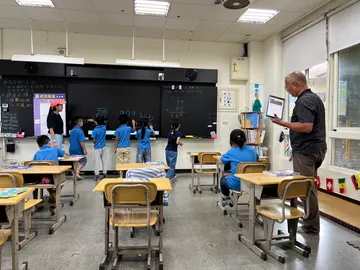
    Source image: How a rural Taiwanese first grader rebuilt his confidence that he could learnSource

    How a rural Taiwanese first grader rebuilt his confidence that he could learn

    Teach For Taiwan (TFT) published alumna Tsai Chi-pei’s recollection of her teaching. While serving in Gukeng Township, Yunlin County, she observed that a first grader, Xiao-yu, often said “I can’t” after comparing himself with his older sister and drawing on earlier classroom experiences. The teacher began using manipulatives, stories and games to help him learn to tell time, and noticed that he later became more willing to ask questions and practise. This is one teacher’s retrospective account of an individual child. Changes in achievement cannot be attributed to any single teaching method, and the account does not represent all students in rural areas.

    Why read: A concrete account of how a teacher responds when a student doubts her own ability in a rural classroom. It can support discussion of teacher–student relationships, psychological safety around mistakes and everyday remedial teaching.

  1. Ministry of Education of the People’s Republic of China
    ChinaUpdate
    Topic illustration of a teacher and students discussing books and ideasIllustration

    Science education’s Learning by Doing initiative calls for at least one inquiry task each semester

    The Ministry of Education introduced the action guidelines, which call for inquiry-based practice to be organized within existing instructional hours. Each student is to complete at least one task per semester, lasting no fewer than four class periods, with an emphasis on process-based assessment. The quality of implementation will still depend on teachers, resources and local arrangements.

    Why read: The guidelines specify the frequency and instructional time for classroom inquiry, making them useful alongside resources on implementation.

  1. Journal of East China Normal University
    ChinaResearch
    Topic illustration of education researchers examining charts and notesIllustration

    Survey of 3,483 teachers finds an association between time pressure and knowledge sharing

    The study analyzed 3,483 questionnaire responses from primary and secondary school teachers using structural equation modeling to examine knowledge sharing and its associations with sharing capacity, collaborative lesson planning and time pressure. The survey model describes patterns of association; by itself, it cannot prove that reducing workload will increase knowledge sharing.

    Why read: The findings offer a mechanism to examine in the organization of school-based professional learning.

  1. Journal of East China Normal University
    ChinaResearch
    Topic illustration of education researchers examining charts and notesIllustration

    Comparing teaching texts from six large language models: strength in higher-order questions does not mean classroom effectiveness

    The study compared multidisciplinary teaching texts generated by six large language models with teachers’ instructional materials, using three dimensions: value guidance, knowledge construction and thinking development. The objects of evaluation were texts, not student learning outcomes; the findings cannot establish that large language models teach better than teachers in classrooms.

    Why read: Provides a concrete research design and clear boundaries around what is evaluated in discussions of large language models for education.

  1. Ministry of Education of the People’s Republic of China
    ChinaUpdate
    Topic illustration of a teacher and students discussing books and ideasIllustration

    Vocational education reform extends from program catalogues to curricula, teachers and practical training

    The Ministry of Education identifies programs, curricula, textbooks, teachers and internships and practical training as linked elements for reform, and calls for a related standards system to be in place by 2027. The document addresses alignment between education and industry, but its intended goals should not be presented as an already established and effective new model.

    Why read: A formal policy on restructuring vocational education and teaching, distinct from general announcements of agreements or school–industry publicity.

You have reached the end