Skip to content
Interface language
  1. UNESCO
    InternationalResearch

    Topic illustration of education researchers examining charts and notesIllustration

    UN agencies report that more than half of Afghanistan's primary-school-age children are outside formal education

    A new UNESCO and UNICEF report says 53% of Afghanistan's primary-school-age children are outside formal general education and describes restrictions on girls' education and problems with learning quality. The material checked so far is the agencies' press release; the underlying survey methods still need to be checked against the full report.

    Why read: A major new report addressing both access to education and learning quality.

  1. World Bank
    InternationalResearch
    Topic illustration of education researchers examining charts and notesIllustration

    World Bank Uses Implementation Science to Track Education Reform, Distinguishing Reach from Learning Outcomes

    The World Bank describes a remedial-teaching model piloted in 400 Rwandan schools, along with related baseline and midline surveys, and notes that learning outcomes still require future evaluation. A separate teacher-training project has reached many schools, but the number reached cannot substitute for improvements in student skills.

    Why read: Clearly illustrates the distinction between evidence about implementation and evidence about outcomes.

  2. Education Endowment Foundation
    InternationalResearch
    Source image: UK Randomized Trial: AI Lesson-Planning Tool Saves Time, but Willingness to Use It VariesSource

    UK Randomized Trial: AI Lesson-Planning Tool Saves Time, but Willingness to Use It Varies

    EEF reports an NFER randomized trial involving 464 teachers at 108 schools: the Aila group spent about 76% as much time planning as the control group on average, but use declined over ten weeks. The study measured planning time and resource quality; it does not show that student achievement improved.

    Why read: An empirical case for distinguishing tool efficiency, adoption behavior, and learning outcomes.

  1. OECD
    InternationalResearch
    Topic illustration of education researchers examining charts and notesIllustration

    OECD Education at a Glance Focuses on Teacher Shortages: Cross-National Averages Need to Be Read in Context

    The OECD's 2026 Education at a Glance highlights teacher shortages, reporting that about 9.1% of primary and secondary teachers in the sampled countries were not fully qualified. The indicator is comparable across countries, but national definitions, missing values, and reference years differ; the average cannot be used directly to assess a particular country's schools.

    Why read: A foundational data entry point for comparing education systems internationally.

  1. Education Endowment Foundation
    InternationalResearch
    Source image: Large-Scale UK Trial: Mathematics Reasoning Program Yields an Average Gain Equivalent to About One MonthSource

    Large-Scale UK Trial: Mathematics Reasoning Program Yields an Average Gain Equivalent to About One Month

    EEF reports a randomized trial involving 6,291 Year 2 pupils in 238 schools. On average, the mathematics reasoning program group made progress equivalent to about one month more than the usual-teaching group. The “month” is an EEF equivalence metric; it does not mean each student actually received one additional month of instruction.

    Why read: A classroom intervention trial with an independent evaluation and a relatively large sample.

  1. UNICEF
    InternationalResearch
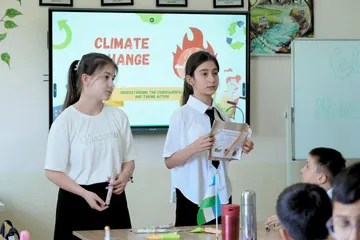
    Source image: UNICEF Estimates Climate Disasters Disrupted Learning for More Than 171 Million Students in 2025Source

    UNICEF Estimates Climate Disasters Disrupted Learning for More Than 171 Million Students in 2025

    In an analysis published in September 2026, UNICEF estimated that climate disasters disrupted the education of more than 171 million students worldwide in 2025. This is a retrospective estimate, not a count of disruptions that have already occurred in 2026; the numbers affected by different disasters cannot simply be added together.

    Why read: Climate risk is an important global issue for continuity of education.

  1. Education Endowment Foundation
    InternationalResearch
    Source image: Schools in England Report: Literacy and Attendance Are the Main Barriers for Disadvantaged PupilsSource

    Schools in England Report: Literacy and Attendance Are the Main Barriers for Disadvantaged Pupils

    An EEF-commissioned analysis of more than 1,200 Pupil Premium strategy statements from schools in England found that 91% mentioned literacy and English issues and 83% mentioned attendance. It reflects challenges identified by schools in their documents; it is not an independent measure of students' skills or absences.

    Why read: Shows how schools define problems and reminds readers to distinguish self-reports from outcomes.

  1. OECD
    InternationalResearch
    Topic illustration of a teacher and students learning with digital tools and booksIllustration

    OECD Digital Education Outlook: better assignment performance with generative AI does not necessarily mean learning

    The OECD’s 2026 Digital Education Outlook discusses the use of generative AI in teaching, learning and governance. It cautions that when a task is handed directly to AI, assignment performance may improve without a corresponding gain in learning. The report offers policy and research recommendations; it does not mean every tool has been evaluated for causal effects.

    Why read: Offers international evidence and a clear distinction between performance and learning for discussions of AI in classrooms.

You have reached the end